Using the VCF Section Tables
The Product Volume Correction Factors calculation references tables maintained by the Analysis Framework. The following explains the tables and how to add or change items in the tables. Tables are provided for the two most common methods of making a volume correction due to thermal expansion of a liquid. The calculation method used is dependent on which table has the material name listed.
Use the equations described in this appendix to calculate volume correction factors for petroleum products for specific temperature and density ranges, listed in the table below. Four sets of equations are described:
- VCF Equation Set 1 - Describes how to calculate VCF with American Petroleum Institute (API) equations. These are general equations with coefficients specified in a table (SF_VCF Section 1). SF_VCF section 1 table implements API tables 6 A, B and C using the methods documented in API volume 10.
- VCF Equation Set 2 - Describes how to calculate VCF for asphalts using specific equations with fixed coefficients.
- VCF Equation Set 3 - Describes how to calculate VCF for aromatics. These are general equations with coefficients specified in a table (SF_VCF Section 3).
- VCF Equation Set 4 - Describes how to calculate VCF for natural gas liquid NGL materials using specific equations with fixed coefficients.
The following table shows the vcf type and temperature and density ranges for the corrections built into Sigmafine. The values for the vcf type in this table are the values that you need to enter in the vcf type column in the SF_Material table.
Material Classes and Temperature / Density Ranges
| Material | Temperature Range (F) | Density Range (API) | VCF Type |
|---|---|---|---|
| Crude Oil | 0 – 3000 – 2500 – 200 | 0 – 4040 – 5050 – 100 | 1 |
| Gasoline | 0 – 3000 – 2500 – 200 | 0 – 4040 – 5050 – 85 | 2 |
| Jet Fuel, Kerosene, Solvents | 0 – 3000 – 2500 – 200 | 0 – 4040 – 5050 – 85 | 3 |
| Fuel Oil, Heating Oil, Diesel Oil | 0 – 3000 – 2500 – 200 | 0 – 4040 – 5050 – 85 | 4 |
| Lubricating Oil | 0 – 300 | -10 – 45 | 5 |
| LPG | - | 102 – 154 | 6 |
| Light Naptha | - | 85 – 102 | 7 |
| Benzene | - | - | 8 |
| Toluene | - | - | 9 |
| m-Xylene | - | - | 10 |
| o-Xylene | - | - | 11 |
| p-Xylene | - | - | 12 |
| Ethyl Benzene | - | - | 13 |
| CycloHexane | - | - | 14 |
| Styrene | - | - | 15 |
| Cumene | - | - | 16 |
| Aromatics (ABP-300F) | - | - | 17 |
| Aromatics (300F-350F) | - | - | 18 |
| Asphalts | 200 – 500 | less than 34.9 API | 19 |
| NGL | - | .5 – .65 SG | 20 |
| No VCF Correction | - | - | 21 |
VCF Equation Set 1
The VCF factor calculated using Equation set 1 is based on product temperature and density.
The base equations are as follows.
Where:
α = Thermal expansion coefficient, (°F-1).
r water = Water density @ base T, (kg/m3).
APIbaseT = Product API at base T.
rbaseT\= Product density @ base T, (kg/m3).
T = Flowing temperature, (°F).
Tbase = Base temperature, (°F).
K0 = Coefficient based on material, (kg2/m6*°F).
K1 = Coefficient based on material, (kg/m3*°F).
VCF = Volume correction factor.
The table, SF_VCF Section 1, lists coefficients used in the equations. The figure below shows the table as it appears in the System Explorer. The temperature columns, TempMin and TempMax are in degrees Fahrenheit (°F). APIMin and APIMax are in units of API. Materials can appear multiple times in the table with different API ranges and different corresponding K0 and K1 factors.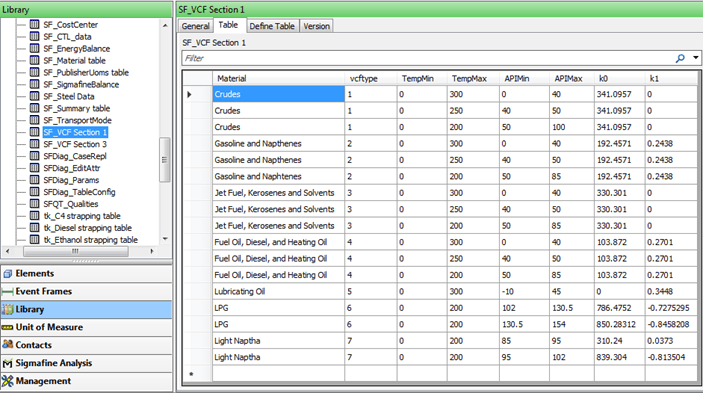
 EXAMPLE: VCF Equation Set 1
Determine the VCF for gasoline at 110 F where the density of the gasoline at base temperature is 55 API. The base temperature is 60 °F.
Density of water is the following.

The temperatures, density and the coefficients for gasoline are the following.
The calculations for the base density, the thermal expansion coefficient, and hence the volume correction factor are as follows.
VCF = 0.96687
VCF Equation Set 2
The correlation for asphalts is based on data for a wide variety of asphalt data gathered from major asphalt producers. The applicable temperature range is between 200 and 500 F.
Then use the same VCF equation as in VCF Section 1.
Then use the same VCF equation as in VCF Section 1.
Where:
α = Thermal expansion coefficient, (F-1).
T = Flowing temperature, (F).
VCF = Volume correction factor.
Determine the VCF for asphalt at 250 °F where the density of the asphalt at base temperature is 15 API. The base temperature is 60 °F.
VCF Equation Set 3
The following equation is used to calculate the VCF for aromatics.

Where:
T = Flowing temperature, (°F).
Tr = Reference temperature, (°F).
b = Equation coefficient, (°F-1).
The table, SF_VCF Section 3, lists coefficients used in the equations. The figure below shows the table as it appears in the System Explorer.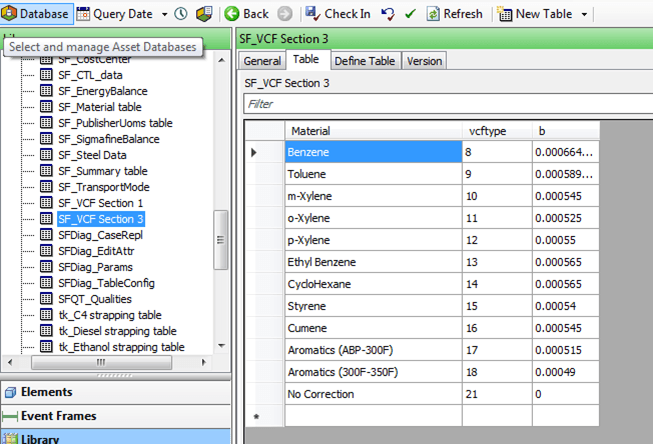
Determine the VCF for m-Xylene at 125 °F where the density of the m-Xylene at reference temperature is 32 API. The reference temperature is 60 °F and the flowing temperature is 125 °F.
B = 0.000545
VCF = 0.96457
VCF Equation Set 4
The following method is used to calculate the VCF for NGL (natural gas liquid) materials. The calculation depends on the specific gravity (SG) of the NGL. The coefficients and equations are taken from the ASTM-API Standard – Table 54.
SGbase = Specific Gravity at the base temperature
Tbase = Base temperature in °C
T = Material temperature in °C
VCF = Volume correction factor

Coefficients

The calculation follows in the order of the equations described below:
Equation 1

Equation 2

Equation 3

Equation 4

Equation 5

Equation 6

Equation 7

Equation 8

Equation 9

Equation 10

Equation 11

Equation 12
Equation 13

Equation 14

For a Tbase = 15 C, calculate the VCFs for SGbase of 0.55, 0.61, 0.63, and 0.65 at a temperature T of 65 °C.

The calculation of the VCF is done as for the 0.5 <= SG < 0.6 range, but then the VCF is adjusted by the following equations.
The calculation of the VCF is done as for the 0.5 <= SG < 0.6 range, but then the VCF is adjusted by the following:
The calculation of the VCF is done as for the 0.5 <= SG < 0.6 range, but then the VCF is adjusted by the following:
| SGbase | VCF |
|---|---|
| 0.55 | 0.8693 |
| 0.61 | 0.9147 |
| 0.63 | 0.92079 |
| 0.65 | 0.9262 |