NGL and LPG Calculations of Liquid Volume VCF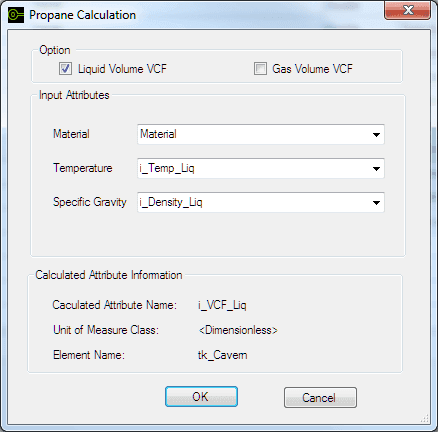
This routine provides a VCF value to convert liquid at a temperature to liquid at a base temperature, using Standard [1], which covers a 60 °F relative density range of 0.3500 to 0.6880, which nominally equates to a density at 15 °C of 351.7 to 687.8 kg/m3 and a density at 20 °C of 331.7 to 683.6 kg/m3. The temperature range is -50.8 to 199.4 °F (-46 to 93 °C). At all conditions, the pressure is assumed to be at saturation conditions.
Liquid VCF Implementation Procedure (60°F base temp)
This section provides the implementation procedure for the computation of Temperature Correction Factor, CTL. The CTL is used to calculate volumes of fluid at the base temperature from volumes at some known measurement temperature. The fluids are characterized by the specification of relative density at the base temperature, 60 °F
Inputs
| Input | Description |
|---|---|
| RD60 | The Relative Density of fluid (at 60°F) |
| TF | The observed temperature of the liquid (°F) |
Outputs
| Output | Description |
|---|---|
| VCF liq | The Volume correction factor that converts liquid volume at an actual temperature to an equivalent liquid volume at a base temperature (at 60°F). |
Assumption
VCF = CTL
The calculations are performed using an extended two-fluid corresponding states equation. By comparing densities at 60°F, two reference fluids are selected so that one is slightly more dense and one is slightly less dense than the observed fluid. The densities of these reference fluids are then scaled to the observed reduced temperature. CTL is then computed from the reference fluid densities.
| Step Number | Operation / Procedure at the step |
|---|---|
| 1 | Round RD60 to the nearest 0.0001 and TF to the nearest 0.1 °F |
| 2 | Convert the rounded observed temperature to units of Kelvin, Tx: |
| 3 | The resultant temperature Tx and RD 60 must within the following boundaries:Temperature between 227.15 and 366.15 K, inclusive (equivalent of -46 to 93°C or -50.8 to 199.4°F)Relative density between 0.3500 and 0.6880, inclusive.If these values do not fall in these ranges, then the standard doesn’t apply. Flag this result (by returning a -1 for CTL) and exit the procedure. |
| 4 | From Appendix A, determine the two adjacent reference fluids to be used for the calculations. Choose the lowest density reference fluid that has a density value greater than or equal to RD60 and refer to this fluid using the subscript “2”. Also, use the next lowest density reference fluid and refer to this fluid using the subscript “1”. |
| 5 | Using Appendix A, 60 °F relative densities, compute the interpolation variable, d: |
| 6 | Using Appendix A critical temperatures, calculate the fluid critical temperature, Tc: |
| 7 | Compute the fluid’s reduced observed temperature, Tr,x:If the reduced temperature Tr,x is greater than 1.0 the fluid is at super-critical conditions and cannot exist as a liquid. Flag this result (by returning a -1 for CTL) and exit the procedure |
| 8 | Compute the reduced temperature at 60°F, Tr,60: |
| 9 | From Appendix A critical compressibility factors, Zc and critical densities ρc, calculate the scaling factor, h2: |
| 10 | Calculate the saturation density for both reference fluids at 60 °F using the 60° reduced temperature, Tr, 60. For each fluid, the equations to calculate the saturation density at any reduced temperature Tr are:where the k1, k2, k3, and k4 parameters are different for each reference fluid and are listed in Appendix A. Refer to the calculated density for the first reference fluid as and for the second reference fluid as |
| 11 | Calculate the interpolating factor X: |
| 12 | Obtain the saturation density for both reference fluids at reduced observed temperature Tr,x using the procedure in step 10. Refer to the calculated density for the first reference fluid as and to the second reference fluid as |
| 13 | Calculate the Temperature Correction Factor at the observed temperature, CTL: |
| 14 | Round the temperature correction factor CTL to the nearest 0.00001. Exit this procedure. |
EXAMPLE: Utilize Propane and i-Butane for VCF Liquid Calculation
| Name | Units | Value |
|---|---|---|
| RD60 | SG | 0.540020 |
| TF | °F | 155.0400 |
| Tx | K | 341.50556 |
| d | dimensionless | 0.5912871 |
| Tc | K | 392.290298 |
| Tr,x | dimensionless | 0.8705430 |
| Tr,60 | dimensionless | 0.7359488 |
| h2 | dimensionless | 1.2633261 |
| gram-mole/liter | 12.0167278 | |
| gram-mole/liter | 9.4300005 | |
| X | gram-mole/liter | 11.9552762 |
| gram-mole/liter | 10.2271386 | |
| gram-mole/liter | 8.0246925 | |
| CTL(VCF_liq) | dimensionless | 0.8510156 |
| Final CTL(VCF_liq) | dimensionless |