Transfers with Zero or Missing Values
This analysis rule includes the transfer elements that have zero measurement value or a non-numeric value. A transfer that has a zero or non-numeric value can indicate the following.
- Missing data for the measurement or if the Attribute is calculated, missing or zero value data from the calculation. This can include a zero density or mass if calculating volume.
- Transfer is a self-calculating transfer without the self-calculating flag set.
The following table lists a sample log output for this analysis.
Sample Log
| Time | Severity | Element | Attribute | Message |
|---|---|---|---|---|
| 7/25/2005 13:22 | …REPORTING TRANSFERS WITH ZERO OR MISSING VALUES – BASIS = MASS | |||
| 7/25/2005 13:22 | Error | TransferA | Basis: Mass (lb), zero Temperature, zero Density, zero Material; Source: NodeA; Destination: NodeB |
Analysis Method
- Collect a list of all transfer elements within the time range of the Case that satisfy the following criteria:
- Status Attribute value is IS (In Service)
- If the transfer is marked as self-calculating, remove it from the analyzed list for measurement. These transfers will receive values in the Mass or Volume Balance Analysis. Do include an analyzed list for missing values in the following: density, temperature, tolerance, and material.
- If the transfer is not a self-calculating transfer, check for zero or non-numeric values in the following for each in-service transfer: measurement, density, temperature, tolerance.
- Check for a blank or bad name in the material attribute.
- Write to the log section of the case. Report the test name and the Measurement Basis. Report the list of offending transfers, ordered by name and cause of violation.
Configuration Using the Wizard
The configuration of the Transfers with Zero or Missing Values calculation is a selection of the General Gross Error Analysis Rule. You open the window for configuring the test (shown in the following figure) from the General Gross Error Analysis Rule Wizard.
Open the Gross Error Configuration window as described in Configuring - General Gross Error Analysis Rule.
On the Transfers tab, select Transfers with zero or missing values.
A Transfers with zero or missing values - Attributes window opens.
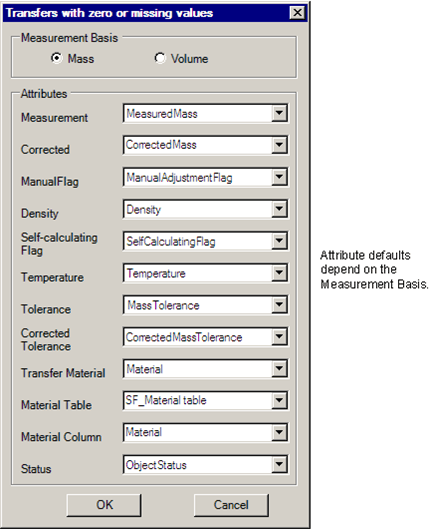
Select measurement basis and the Attributes according to the following table:
Attributes
Selections Description Measurement Basis Select either mass or volume basis. Measurement Actual measurement. The default is 'MeasuredMass' or 'NetVolume' depending on mass or volume selection. Corrected Select the corrected measurement for the transfer. The default is 'CorrectedMass' or 'CorrectedVolume' depending on mass or volume selection. Manual Flag Flag to indicate if a corrected measurement was used for the transfer. The default is to 'ManualAdjustmentFlag'. Density The density of the material of the transfer. The default is 'Density'. Self-calculating Flag Indicates if the measurement is automatically calculated by the Sigmafine reconciliation solver. Default is 'SelfCalculatingFlag'. Temperature The temperature of the transfer. The default is to 'Temperature'. Tolerance Measured value tolerance. The default is to 'MassTolerance' or 'VolumeTolerance' depending on mass or volume selection. Corrected Tolerance Transfer corrected value tolerance. The default is to 'CorrectedMassTolerance' or 'CorrectedVolumeTolerance' depending on mass or volume basis selection.. Transfer Material The material name in the transfer. The default is to 'Material'. Material Table Material table name. Default is 'SF_Material table'. Material Column Name of the column in the material table that contains the material. The default is 'Material". Status Transfer in/out of service status. The default is to 'ObjectStatus'. Click OK to finish the configuration.
The text "CONFIGURED" displays next to the 'Transfers with zero or missing values' selection.
To run this test, see Running the General Gross Error Analysis.