Meters with Zero Measurement / Tolerance
This analysis rule includes the mass/volume measurement elements with a zero measurement, a zero tolerance on that measurement, or both. For processes that are in service, zero measurements are abnormal and can be the result of a meter error or a data communication error. The setting of a zero tolerance on a measurement allows no error to be placed on that value in the balancing calculations, such as the mass balance. Since you can run the General Gross Error analysis as a validation step in the mass and volume balances, zero tolerance is a potential gross error.
Any in-service meter measurement with a zero measurement or measurement tolerance is reported to the Case log, which you can view in the Log tab of the Case Properties window. The output contains a list of meters in violation, and a description of the violation.
The following table lists a sample log output for this analysis.
Sample Log
| Time | Severity | Element | Attribute | Message |
|---|---|---|---|---|
| 9/25/2005 13:22 | ...REPORTING METERS WITH ZERO MEASUREMENT/ZERO TOLERANCE - BASIS= MASS | |||
| 9/25/2005 13:22 | Error | MeterA | MeasuredMass | Zero measurement MeasuredMass: 0 (kg); Attached Flow: SF_FlowA; Source: SFNodeA; Destination: SF_NodeB |
| 9/25/2005 13:22 | Error | MeterB | MassTolerance | Zero tolerance MassTolerance: 0 (kg) ,; Attached Flow: SF_FlowB; Source: SF_NodeB; Destination: SF_NodeC |
Analysis Method
- Collect a list of all meter elements in the current Case that satisfy the following criteria:
- Status Attribute value is IS (In Service).
- Determine the meter elements with a zero mass or volume measurement (depending on the measurement basis selection), a zero measurement tolerance, or both. If the flag indicating a corrected value is available, the corrected value is used.
- Write to the log section of the case. Report the test name and the Measurement Basis. Report the list of offending meters, ordered by name and cause of violation.
Configuration Using the Wizard
The configuration of the Meters with Zero Measurement or Tolerance is a selection of the General Gross Error Analysis Rule. You open the window for configuring the test (shown in the following figure) from the General Gross Error Analysis Rule Wizard.
Open the Gross Error Configuration window as described in Configuring - General Gross Error Analysis Rule.
On the Liquid/Gas Meters tab, select Meters with zero measurement / tolerance.
A Meters with zero measurement / tolerance - Attributes window opens.
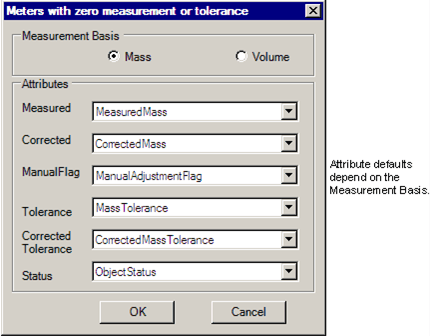
Select the measurement basis and the Attributes according to the following table:
Attributes
Selections Description Measurement Basis Select mass or volume measurement basis for comparison. Measured Meter actual measurement. This defaults to 'MeasuredMass' or 'MeasuredVolume' depending on mass or volume selection. Corrected Meter corrected measurement. This defaults to 'CorrectedMass' or 'CorrectedVolume' depending on mass or volume selection. Manual Flag Flag to indicate if a corrected measurement was used for the meter. This defaults to 'ManualAdjustmentFlag', Tolerance Meter Tolerance. The default is to 'MassTolerance' or 'VolumeTolerance' depending on mass or volume selection. Corrected Tolerance Meter tolerance on corrected value. The default is to 'CorrectedMassTolerance' or 'CorrectedVolumeTolerance' depending on mass or volume selection. Status Meter in/out of service status. This defaults to 'ObjectStatus'. Click OK to finish the configuration.
The text "CONFIGURED" displays next to the 'Meters with zero measurement / tolerance' selection.
To run this test, see Running the General Gross Error Analysis.